Tamil Nadu Showcases Advanced Manufacturing and Tech Prowess to High-Level Kazakh Delegation in Chennai


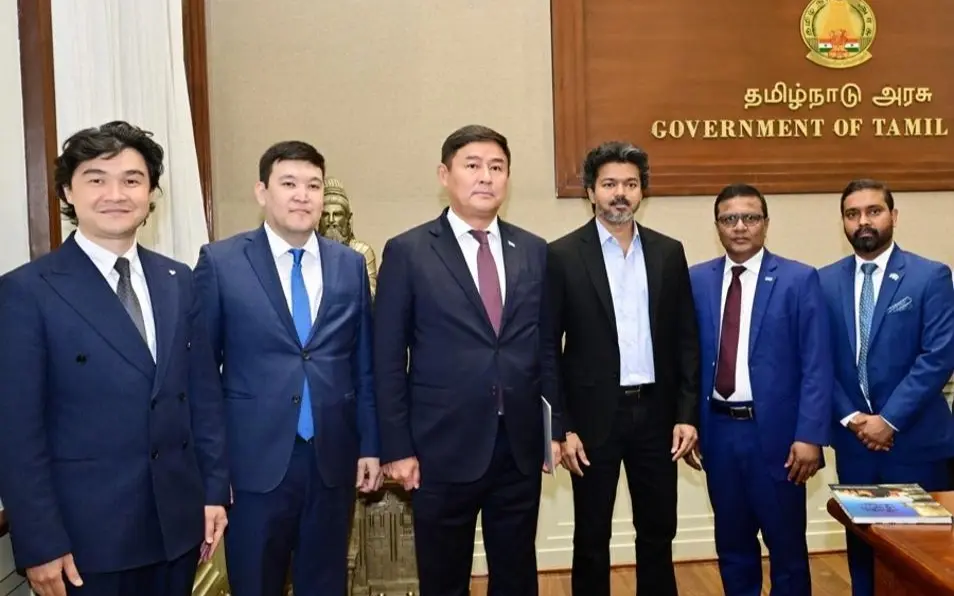
CHENNAI — In a major step toward deepening bilateral economic ties and cross-border trade, the Government of Tamil Nadu hosted a high-level trade and business delegation from the Republic of Kazakhstan during the India–Kazakhstan Business Forum held in Chennai.
The bilateral interaction focused on showcasing Tamil Nadu’s industrial, manufacturing, and technological capabilities while positioning the southern state as a gateway for Kazakh enterprises seeking entry and expansion into the Indian market.
High-Level Representation Across Key Kazakh Regions
The visiting Kazakh delegation was led by Aidar Abildabekov, Vice-Minister of Trade and Integration of the Republic of Kazakhstan. The delegation comprised senior leadership and regional representatives from Aqmola, Atyrau, Mangystau, and Turkestan, alongside the Deputy Mayor of Shymkent.
More than 65 Kazakh enterprises spanning diverse industries attended the forum, engaging in business-to-business (B2B) dialogues and exploring strategic joint ventures, supply-chain tie-ups, and technology exchange.
Also addressing the forum was H.E. Y.K. Sailas Thangal, Ambassador of India to Kazakhstan, highlighting the pivotal role diplomatic missions and bilateral chambers play in bridging Central Asian supply chains with Indian industrial corridors.
Strategic Complementarities & Sectors of Mutual Interest
Addressing the delegation, Minister for Industries, Investment Promotions and Commerce S. Keerthana emphasized the natural synergies between Tamil Nadu’s manufacturing-led growth and Kazakhstan’s expanding trade footprint:"Tamil Nadu and Kazakhstan have complementary strengths, and there is considerable scope to build a stronger economic partnership. We see Kazakhstan as an important gateway to Central Asia, while Tamil Nadu offers a strong hub of Indian exports."
Key sectors highlighted during bilateral discussions included:
Automotive & Auto Components: Leveraging Tamil Nadu’s position as India's premier auto hub for vehicle components and equipment export.
Information Technology & Digital Solutions: Exploring software services, SaaS, and digital public infrastructure collaboration.
Pharmaceuticals & Healthcare: Sourcing high-quality generic formulations and active pharmaceutical ingredients (APIs).
Textiles & Apparel: Utilizing integrated supply chains from yarn production to technical garments.
Logistics, Warehousing & Multimodal Transport: Linking Central Asian trade corridors with South Indian port-led industrial clusters.
Food Processing & Agri-tech: Value-addition, grain handling, and cold-chain logistics.
Tourism & Cultural Exchange: Boosting business travel and two-way tourism connectivity.
Facilitating Institutional Partnerships and Inward Investment
Senior state officials participating in the deliberations included:
S. Vijayakumar, Additional Chief Secretary to Government (Industries)
K. Vivekanandan, Special Secretary
Pallavi Verma, Executive Director, Guidance Tamil Nadu (the state's nodal investment promotion agency)
Guidance Tamil Nadu offered dedicated support to Kazakh investors, detailing the state’s streamlined single-window clearance mechanisms, specialized industrial parks, and competitive incentive packages.
"Tamil Nadu is committed to deepening its engagement with Kazakhstan and converting this growing interest into concrete investments, business partnerships, and lasting economic linkages," Minister Keerthana affirmed, inviting Kazakh companies to establish regional operational bases in the state.
What This Means for the India–Kazakhstan Business Corridor
The Chennai forum marks an important milestone in expanding India–Kazakhstan commerce beyond the traditional national capital corridors, directly engaging India’s most industrialised states. For the member businesses of the India–Kazakhstan Business Council (IKBC), this opens up tangible opportunities to participate in:
Direct sourcing partnerships in engineering goods, electronic hardware, and pharma products.
Co-manufacturing ventures catering to domestic Indian demand and broader export markets across Southeast Asia.
Logistics and trade facilitation via regional connectivity initiatives connecting Central Asia to South Indian ports.


Comments